Coupon vs Promo Code vs Voucher vs Gift Card: What's the Actual Difference?
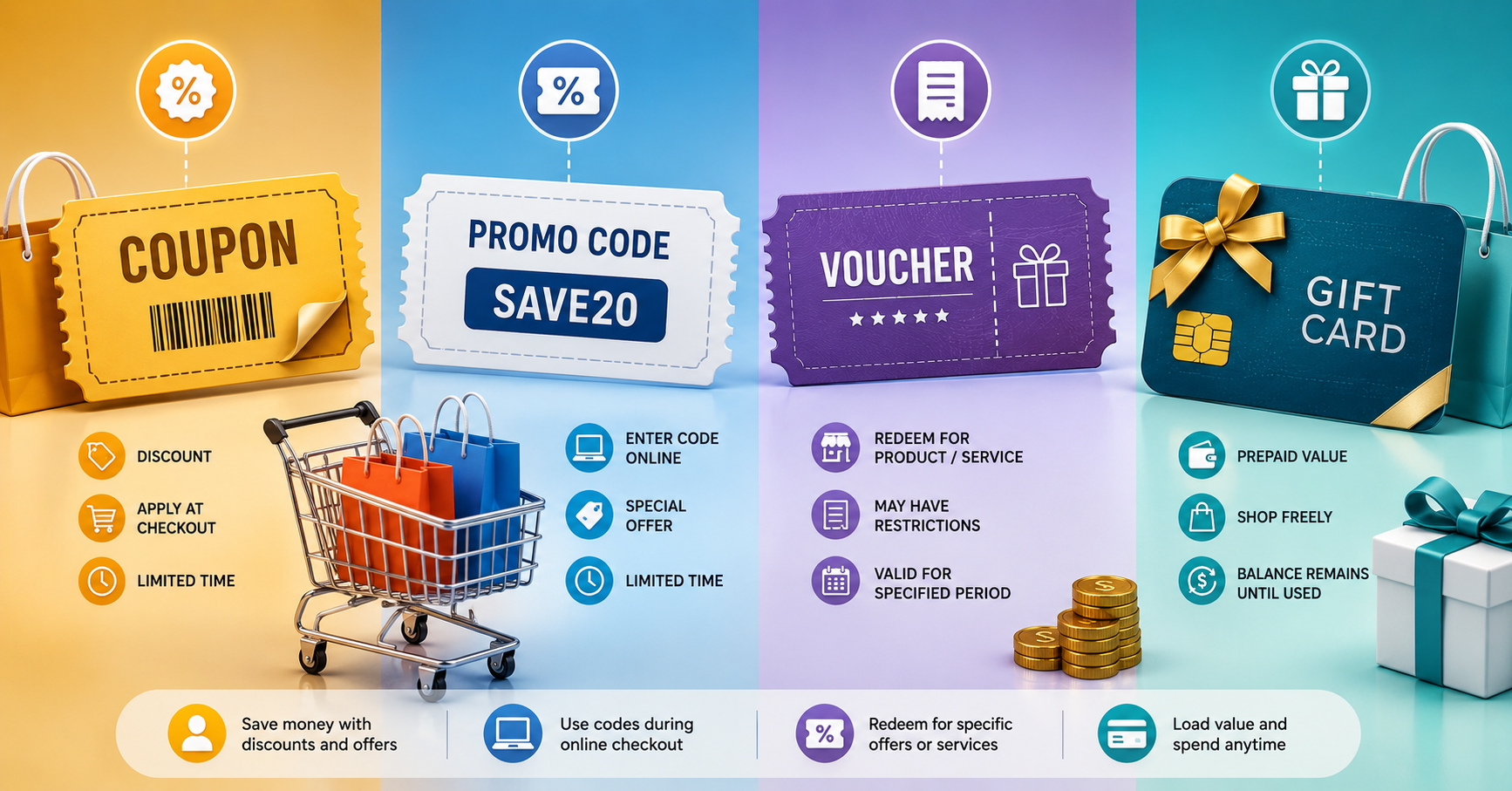
Modern online shopping is filled with coupons, promo codes, vouchers, cashback offers, reward points, and gift cards — and at first glance, many of these terms appear interchangeable. Consumers routinely use "coupon code," "promo code," "voucher," and "gift card" as if they all mean the same thing. In reality, these systems work very differently.
Understanding the differences matters because:
- shoppers want maximum savings,
- brands use these tools strategically,
- search engines classify them differently,
- and reward ecosystems increasingly depend on semantic clarity.
Today, millions of people search for "coupon meaning," "promo code vs coupon," "what is a voucher," "how gift cards work," "discount code meaning," and "cashback vs coupons." At the same time, businesses use these systems for customer acquisition, retention, remarketing, loyalty building, and digital commerce growth.
This guide explains what coupons, promo codes, vouchers, and gift cards actually are, how each system works, where they are commonly used, how brands benefit from each, and what most consumers misunderstand about reward ecosystems in 2026.
Why People Confuse Coupons, Promo Codes, Vouchers, and Gift Cards
All of Them Reduce Spending in Some Way
The main reason consumers confuse these terms is that all of them can lower costs, provide value, or reduce out-of-pocket spending in some form. The end effect — paying less, or paying with something other than cash — looks superficially identical at the moment of checkout, even when the underlying mechanics are very different.
Digital Commerce Blurred Traditional Definitions
Historically, paper coupons, store vouchers, and gift certificates were clearly separate systems with distinct physical formats and clear consumer mental models. But e-commerce platforms combined digital discounts, promotional codes, wallet credits, cashback systems, and stored-value rewards into interconnected ecosystems — collapsing the old visual and behavioural distinctions into a single "enter code here" checkout field.
Brands Often Use Terms Interchangeably
Some companies loosely use "coupon," "code," "voucher," and reward terminology for marketing simplicity — calling the same offer a coupon in an email, a voucher in an app banner, and a promo code in a push notification. This kind of casual swapping makes the marketing easier to write but actively trains consumers to treat the four systems as synonyms, which they are not.
What Is a Coupon?
Coupon Definition
A coupon is a discount mechanism that reduces the price of a product or service. It is the broadest category in this comparison — any tool whose primary job is "make this purchase cheaper" qualifies. Coupons may provide percentage discounts, fixed-value discounts, buy-one-get-one offers, free shipping, or special promotional pricing.
Traditional Coupons vs Digital Coupons
Historically, coupons existed as newspaper cutouts, printed store offers, or physical promotional slips that shoppers carried into a store. Today, digital coupons dominate online shopping ecosystems — they live inside app wallets, email inboxes, browser extensions, and account-tied loyalty programs, applied either with a code or automatically at checkout.
How Coupons Work
Coupons generally activate discounts, reduce checkout totals, or unlock specific promotional benefits. They are usually tied to conditions such as expiry dates, minimum spending requirements, eligible category restrictions, single-use limits, or campaign-wide redemption caps. The conditions are the small print that determines whether the headline saving actually lands.
Most Common Coupon Types
Popular coupon categories include percentage discounts ("20% off"), flat discounts ("₹500 off orders over ₹2,000"), free shipping coupons, category-based offers (electronics only, fashion only), and first-order promotions reserved for new accounts. Each category serves a different brand goal — flat discounts protect margin on high-ticket items, percentages drive cart-size, and first-order codes exist purely for customer acquisition.
What Is a Promo Code?
Promo Code Definition
A promo code is a digital alphanumeric code used to unlock promotional discounts during checkout. Examples include SAVE20, FIRSTORDER, WELCOME50, or seasonal campaign codes like SUMMER2026. The code itself is the key that activates the offer — without entering it, the discount does not apply, even if the rest of the cart qualifies.
Promo Codes Are Usually Entered Manually
Users typically copy, paste, or type promo codes into a dedicated field during checkout. The manual entry step is part of the design: it forces an explicit action from the shopper, which both confirms intent and lets the platform attribute the redemption to a specific code, campaign, or channel.
Promo Codes Are Primarily Digital
Unlike traditional coupons, promo codes are heavily associated with e-commerce, mobile apps, digital campaigns, and influencer marketing. They are rarely seen in offline retail because the "enter this code" workflow doesn't translate well to a physical till — though QR-based promo codes are slowly blurring this line.
Why Brands Use Promo Codes
Promo codes help businesses track campaigns, measure influencer performance, personalize marketing, and improve conversion rates. The discount is only half of the value — the other half is the data trail. A unique code per channel tells the brand exactly which ad, creator, or email drove the redemption, which is something a generic auto-applied discount cannot reveal.
Coupon vs Promo Code: What's the Difference?
The cleanest way to think about it: every promo code is a coupon, but not every coupon is a promo code. The table below maps the five dimensions on which they diverge.
| Feature | Coupon | Promo Code |
|---|---|---|
| Format | Physical or digital | Mostly digital |
| Activation | Automatic or manual | Usually manual code entry |
| Usage | Retail & online | Mostly online |
| Purpose | Discount mechanism | Promotional tracking + discount |
| Complexity | Broader category | Specific digital implementation |
What Is a Voucher?
Voucher Definition
A voucher is a prepaid or entitlement-based value instrument that can be redeemed for products, services, discounts, or credits. The defining feature isn't the medium (digital or physical) but the entitlement — a voucher gives you the right to claim something specific, rather than a generic reduction off whatever you happen to buy.
Vouchers Often Represent Stored or Assigned Value
Unlike promo codes, vouchers often carry monetary value, prepaid credit, or redemption entitlement. A ₹500 food-delivery voucher is not the same as a "₹500 off" promo code — the voucher behaves like an account credit that gets consumed on redemption, while the promo code is a one-shot discount applied to a separate payment.
Common Voucher Types
Voucher systems include travel vouchers, food vouchers, event vouchers, digital shopping vouchers, and employee benefit vouchers (meal cards, fuel cards, lifestyle perks issued by HR programs). The category is broader than most consumers realise — anything that says "redeemable for X" is structurally a voucher, even when the marketing calls it a "card" or "credit."
Vouchers Are Common in Service Industries
Vouchers are heavily used in travel, hospitality, food delivery, gaming, and entertainment ecosystems. Gaming in particular leans hard on voucher and gift-card mechanics — in-game currency packs, tournament entry credits, and reward-app payouts are usually issued as vouchers rather than cash. For a deeper look at how the gaming earning side of this ecosystem actually works, see our guide to whether you can really earn money playing games.
What Is a Gift Card?
Gift Card Definition
A gift card is a prepaid stored-value product that users can redeem for purchases. Gift cards are usually retailer-specific (Amazon, Flipkart, a department store), digitally redeemable (delivered as an emailed code), or physically issued (plastic cards available at point-of-sale displays).
Gift Cards Function Like Prepaid Currency
Gift cards operate more like a spending balance, wallet credit, or prepaid purchasing power than like a discount. Unlike coupons, they are not necessarily discounts at all — a ₹2,000 gift card represents exactly ₹2,000 of spending power, with the discount (if any) coming from how the card was acquired (a sale, a cashback payout, a corporate reward) rather than from the card itself.
Why Gift Cards Became So Popular
Gift cards became popular because they simplify gifting (no need to guess sizes or preferences), increase flexibility for the recipient, and integrate easily into digital commerce ecosystems. They also solve a real social problem — cash as a gift can feel transactional, and a branded gift card occupies the more acceptable middle ground between cash and a specific product.
Digital Gift Cards Are Growing Rapidly
Modern gift card ecosystems now support instant delivery, app integration, gaming rewards, loyalty system payouts, and cashback redemptions. The gift card has quietly become the default "general-purpose reward" format across most consumer platforms — easier to issue than cash, cleaner than partial refunds, and more flexible than a category-locked voucher.
Gift Card vs Coupon: Major Difference
Gift cards and coupons sit at opposite ends of the value-instrument spectrum: one stores money, the other reduces money. The table below makes the divergence explicit.
| Feature | Gift Card | Coupon |
|---|---|---|
| Nature | Stored monetary value | Discount tool |
| Payment Equivalent | Yes | No |
| Requires Purchase? | Usually yes | Not necessarily |
| Reduces Cost? | Indirectly | Directly |
| Transferable? | Often yes | Rarely |
Voucher vs Gift Card: What's the Difference?
Gift Cards Usually Carry Flexible Spend Value
Gift cards function similarly to a prepaid balance. Users can typically spend them across multiple products in a retailer's catalogue, in any combination, up to the card's value — the only constraint is "where it works," not "what you can buy with it."
Vouchers Are Often Restricted
Vouchers may be category-specific (food only, travel only), service-specific (a hotel-night voucher, a salon-treatment voucher), or redemption-limited (one-time use, single-product redemption). The restriction is the defining feature — it is what makes a voucher cheaper to issue and easier to control than an equivalent gift card.
Gift Cards Focus More on Commerce Flexibility
Gift cards are increasingly integrated into reward ecosystems, cashback systems, and digital payment flows. Their flexibility makes them the preferred payout format for platforms that don't know in advance what their users want to buy — which is why most reward apps default to gift cards rather than category-locked vouchers when paying out earnings.
Why Businesses Use Coupons, Promo Codes, Vouchers, and Gift Cards
Customer Acquisition
Discount systems help businesses attract new customers, improve conversions, and reduce purchase hesitation. A first-order coupon or welcome code is one of the cheapest acquisition tools available — cheaper than paid advertising, more measurable than a brand campaign, and effective on price-sensitive shoppers who would otherwise abandon the cart.
Retention and Loyalty
Reward systems encourage repeat purchases, app engagement, and ongoing customer loyalty. Issuing a returning-customer voucher or stored gift balance is significantly cheaper than re-acquiring a lapsed user through ads — which is why almost every successful e-commerce brand now layers some form of rewards on top of its core checkout flow.
Data and Consumer Tracking
Digital discounts help brands analyze buying behavior, campaign performance, and customer preferences. Every promo code redemption is a labeled data point — who bought what, through which channel, at what discount — and that data quietly powers everything from price testing to creator-marketing attribution.
Reducing Cart Abandonment
Promo codes and discounts often encourage users to complete purchases, increase order size, or finalize checkout decisions. A timely "10% off if you complete checkout in the next 15 minutes" pop-up is structurally identical to a coupon — but framed as urgency, it converts at a far higher rate than the same offer sitting passively on a deals page.
How AI Is Changing Reward and Discount Ecosystems
Personalized Discounts
AI increasingly delivers personalized coupons, dynamic pricing, and behavior-driven promotions. The same shopper now sees different offers across different sessions depending on browsing history, cart value, time of day, and past purchase patterns — the era of one-size-fits-all coupon codes is quietly ending.
Predictive Commerce
Platforms now predict user intent, likely purchases, and conversion behavior with surprising accuracy. The practical result is that the discount you see is often calibrated to the smallest amount needed to convert you — not the maximum the brand is willing to give, which is what generic public codes used to offer.
Smarter Reward Systems
AI-driven systems optimize loyalty rewards, promotional timing, and campaign targeting in real time. Reward platforms now decide which offer to surface to which user at which moment based on models trained on millions of past interactions — a long way from the static "10% off everything" model that defined coupon marketing a decade ago.
Most Common Consumer Misunderstandings
"Everything Is Basically a Coupon"
It's not. Coupons, promo codes, vouchers, and gift cards serve different financial, technical, and marketing purposes — and treating them as a single category leads to predictable shopping mistakes (assuming a gift card is a discount, expecting a voucher to work anywhere, missing the fact that a promo code is being tracked).
Gift Cards Are Not Discounts
Gift cards represent prepaid value, not savings. A ₹2,000 gift card buys ₹2,000 of goods — no more, no less. The discount only enters the picture if you bought the card at a discount, received it as a reward, or used it during a promotional event where the retailer offered extra value on top.
Promo Codes Are More About Tracking Than Many Users Realize
Promo codes often help brands track campaigns, creators, affiliates, and customer behavior — frequently more than they help the consumer. The 10% discount is the visible benefit; the attribution data the brand collects is the part the consumer rarely thinks about, even though it is doing more work behind the scenes.
How Reward Ecosystems Are Evolving in 2026
Commerce Is Becoming Reward-Driven
Modern shopping increasingly combines cashback, coupons, loyalty systems, and wallet-based rewards into a single integrated layer. A checkout flow without some form of reward feels increasingly incomplete in 2026 — and any brand that ignores the reward layer is quietly losing share to brands that build it in by default.
Gamified Savings Are Growing
Brands increasingly use reward psychology, streak systems, points, and engagement mechanics to keep users active. The goal is the same as traditional couponing — repeat purchases and customer retention — but the mechanic borrows from game design: progress bars, milestones, level-ups, and surprise rewards.
Digital Wallet Integration Is Expanding
Gift cards and vouchers are increasingly integrated into UPI ecosystems, fintech apps, and mobile commerce flows. The "code in your email" model is gradually being replaced by a "balance in your wallet" model — easier to track, harder to lose, and ready to apply automatically at checkout.
Best Ways Consumers Use These Systems Strategically
Combining Multiple Savings Layers
Smart shoppers often combine coupons, cashback, promo codes, and gift cards in the same checkout. The trick is that these layers operate at different points in the flow — a promo code reduces the bill at checkout, a gift card pays part of the reduced bill, and cashback returns a percentage afterward — so when stacking is allowed, it compounds.
Tracking Seasonal Promotions
Major sales periods (Big Billion Days, Great Indian Festival, end-of-season sales, year-end clearances) often provide stacked discounts, enhanced cashback, and limited-time offers. Buying outside these windows — even on apparently competitive prices — usually means paying more than necessary on anything that isn't time-sensitive.
Using Reward Ecosystems Intentionally
Experienced users strategically optimize shopping timing, platform choice, and reward redemption rather than buying reactively. A small change in habit — checking for an active code before any purchase, comparing the same item on two platforms with different cashback rates, holding non-urgent purchases for sale events — adds up to meaningful annual savings over a year of shopping.
Which System Is Best for Consumers?
None of these systems is universally "best" — each serves a different use case. The table below maps each system to the situation where it adds the most value.
| System | Best Use Case |
|---|---|
| Coupons | Direct savings |
| Promo Codes | Online checkout discounts |
| Vouchers | Service or category redemption |
| Gift Cards | Flexible prepaid spending |
| Cashback | Long-term spending efficiency |
Quick Summary: Key Differences Explained
| Term | Core Function |
|---|---|
| Coupon | Reduces purchase price |
| Promo Code | Unlocks digital promotion |
| Voucher | Redeemable entitlement/value |
| Gift Card | Prepaid stored-value spending |
| Cashback | Returns part of spending |
Frequently Asked Questions (FAQs)
What is the difference between a coupon and a promo code?
A coupon is the broader category — any discount mechanism that reduces a purchase price, whether it arrives as a printed cutout, a digital offer, or an automatically applied checkout discount. A promo code is a specific digital implementation: an alphanumeric string like SAVE20 or WELCOME50 that you type or paste at checkout to unlock a campaign-tied discount. Every promo code is a kind of coupon, but most coupons are not promo codes — coupons can also be barcode-based, account-tied, or auto-applied without any code to enter.
Are vouchers the same as gift cards?
No, although the two terms get used interchangeably in everyday speech. Vouchers usually carry restrictions — they are tied to a specific category, service, brand, or use case, and may expire faster. Gift cards function more like prepaid spending balance: they hold a monetary value you can spend more flexibly across a retailer's catalogue, often on anything the retailer sells. The simplest test is to ask what the instrument can buy — if the answer is "this specific thing or category," it's a voucher; if it's "anything in the store up to this balance," it's a gift card.
Do gift cards provide discounts?
Not directly. A gift card is prepaid monetary value, not a price reduction. Buying a ₹1,000 gift card and using it at checkout costs the same as paying ₹1,000 directly — the gift card simply moves the payment moment earlier. Gift cards can become indirect discount tools when retailers sell them at promotional rates (a ₹1,000 card for ₹900 during a sale, for example), or when reward platforms hand them out as cashback or loyalty payouts. In those specific cases the saving comes from how you acquired the card, not from the card itself.
Why do brands use promo codes?
Promo codes do double duty: they offer a discount, and they let brands measure where that discount was used. A unique code given to an influencer, an ad campaign, or an email blast tells the brand exactly which channel drove which sales — something a generic auto-applied discount cannot. Brands also use codes to personalize offers (different segments get different codes), to fence promotions to specific audiences (first-order codes, win-back codes), and to control campaign costs by limiting how often each code can be redeemed.
Can shoppers combine coupons and cashback?
Often yes — though it depends on the platform. Many e-commerce sites allow a coupon or promo code to apply at checkout while a separate cashback platform tracks the purchase and refunds a percentage afterward, because the two operate at different layers (the coupon reduces the bill, the cashback returns part of what you paid). Some retailers explicitly block stacking by excluding discounted orders from cashback or by limiting one promo type per order, so it is worth checking the terms of both sides before assuming a stack will work.
Why are reward ecosystems becoming so popular?
Three forces compound. First, digital commerce has made it cheap for platforms to issue, track, and redeem rewards in real time, so they finally make economic sense at scale. Second, customer acquisition costs have risen sharply, which means brands now pay more attention to retention — and reward systems are one of the most reliable retention tools. Third, shoppers themselves have learned to expect rewards: a checkout flow without cashback, points, or coupons increasingly feels incomplete, so any brand that ignores rewards loses to one that uses them well.
Conclusion
Coupons, promo codes, vouchers, and gift cards may appear similar on the surface, but they serve very different purposes within modern digital commerce ecosystems. A coupon reduces the price of something. A promo code reduces the price and lets the brand measure where the discount came from. A voucher gives you a specific entitlement to a specific thing. A gift card gives you flexible prepaid currency to spend as you choose. Four different jobs, four different mechanics — even when they all show up in the same email banner.
Understanding these differences matters because these systems now influence shopping behavior, digital payments, customer loyalty, reward platforms, and online spending psychology globally. In 2026, commerce is increasingly reward-driven, personalized, AI-optimized, and engagement-focused — and the shoppers who know which instrument they are holding tend to extract more value from every checkout than the ones who treat all four as interchangeable.
For consumers, understanding how these systems work can improve savings, shopping efficiency, reward optimization, and financial decision-making. For businesses, the same instruments continue to power customer acquisition, conversion, loyalty, and long-term engagement in an increasingly competitive digital marketplace.
If you want to add a rewards layer that stacks on top of every coupon, promo code, voucher, and gift card you already use, you can start earning cashback and gift cards on PocketsFull — surveys, offers, and tasks with transparent payout rules and zero upfront cost.